
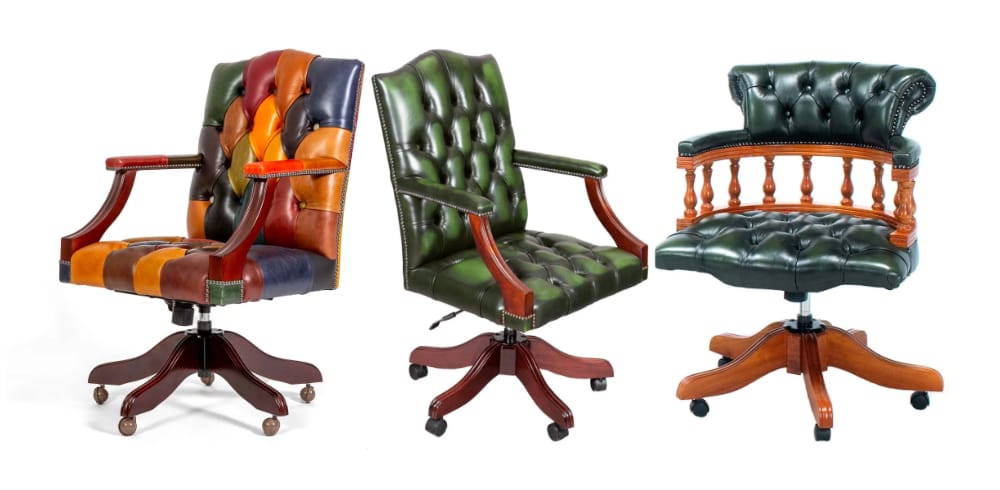
If you’ve ever searched what a captain’s chair is, you’ll probably have noticed something slightly confusing. One result shows a solid wooden armchair with a curved back and spindles. Another shows a deep leather office chair on castors. Search elsewhere and you may even find the term being used for seats in cars and boats.
So which one is the real captain’s chair?
The answer is more interesting than simply picking one design. A captain’s chair is traditionally a sturdy, low-backed armchair closely associated with Windsor-style furniture, but the design has evolved considerably. Today, a leather captain’s chair can combine the recognisable curved shape of the original with upholstery, buttoning and modern office mechanisms.
In this guide, we’ll look at where the chair came from, the features that define it and why the design still works so well in modern homes and offices.
What Is a Captain’s Chair?
Traditionally, a captain’s chair is a substantial wooden armchair with a relatively low curved back, wraparound arms and a series of turned spindles supporting the upper structure. It’s closely related to the Windsor family of chairs, although the exact design varies depending on its age and maker.
Historic examples give us a useful reference point. Historic New England has a captain’s chair dated to around 1870 with nine turned spindles, a curved arm rail and oak construction. Another example from the first half of the 20th century is formally described as a low-back Windsor chair with continuous arms and turned spindles.
That’s an important distinction because captain’s chair furniture has never followed one completely rigid template.
You’ll find versions with a spindle back and exposed solid wood, while others use leather upholstery across the seat, back and arm supports. There are fixed chairs, writing chairs and modern swivel designs. What connects them is usually their enclosed, supportive shape and sense of solidity.
Perhaps the best way to understand the captain’s chair is as a design family rather than an exact blueprint.
That also explains why identifying older examples isn’t always straightforward. In furniture communities, similar chairs are variously described as captain’s chairs, schoolhouse chairs, barrel-back chairs and jury chairs. The terminology can overlap, particularly once you move into antique furniture where manufacturers weren’t necessarily working from today’s neat product categories.
Where Did the Captain’s Chair Come From?
The history becomes slightly murkier here.
Captain’s chairs are commonly associated with ships and naval officers, and it’s easy to see where that idea comes from. The curved backrest and turned spindles can resemble traditional ship railings, while the name itself suggests a chair intended for someone in authority.
At Chesterfield Sofa Company, our own Captain’s Chair keeps that visual connection through its curved back and turned spindles, which are designed to recall the deck railings of traditional timber ships.
It’s worth being cautious, though, about claiming that somebody designed the first captain’s chair specifically for a ship’s captain. The historical record isn’t quite that tidy.
The furniture itself overlaps strongly with the Windsor tradition, which emerged in Britain during the early 18th century. Windsor chairs became recognisable for features such as solid wooden seats, spindle backs and turned legs, and the design spread far beyond formal interiors because it combined strength with relatively economical construction.
Captain’s chairs appear to sit within that broader tradition. Historic New England even describes an 1825-1874 child’s chair as being in “captain’s chair form”, complete with a rounded crest, arms and multiple turned spindles.
By the later 19th and 20th centuries, the style had become familiar well beyond nautical settings. Anecdotally, people still remember these chairs from government buildings, schools, libraries and offices. One discussion about an older wooden example brought up memories of similar chairs in courthouses and official buildings, with several users commenting on just how solid they were.
That durability may actually explain more about the design’s longevity than the romantic naval story. A good traditional captain’s chair is compact, difficult to knock around and structurally robust. It suited working environments, and it still does.
What Does a Captain’s Chair Look Like?
There’s no single feature that turns any wooden armchair into a captain’s chair. Instead, several details usually work together.
The most recognisable is the curved upper structure. On a traditional captain’s chair, the back frequently sweeps into the arms rather than treating the two as completely separate elements. This creates the almost wraparound shape associated with classic chair design.
Spindles are another strong clue. Historic examples can feature several turned wooden spindles between the seat and the continuous arm or back rail. They provide support without making the chair visually heavy.
Then there’s the seat itself. Traditional versions may have exposed timber or cane, while upholstered interpretations offer significantly more cushioning.
Modern Chesterfield versions take the underlying silhouette and move it towards traditional office furniture. Our Captain’s Chair, for example, combines a beechwood frame with a curved back, turned spindles and a choice of plain or buttoned leather seating. Each chair is handmade in our Lancashire workshop and can be ordered in more than 100 premium leathers.
It’s a good example of how the form has evolved without losing its identity.
Even museums show that leather isn’t incompatible with the idea of a captain’s chair. The Metropolitan Museum of Art holds Wharton Esherick’s 1958 Captain’s Chair, constructed from walnut, cherry and leather.
So, if you’re trying to decide whether a leather captain’s chair is somehow less “authentic” than a completely wooden armchair, we wouldn’t look at it that way. Furniture styles rarely remain frozen in one period. Materials and mechanisms change while recognisable proportions survive.
How Are Captain’s Chairs Used Today?
For most of our customers, the modern captain’s chair makes the most sense as an office or study chair.
That’s partly visual. Put a generic mesh task chair behind a traditional wooden desk and it can look like it belongs to a different room. A captain’s chair carries enough character to sit comfortably alongside timber furniture, bookcases and other classic pieces.
It can also work surprisingly well where space is limited. Compared with a towering executive chair, the lower curved profile tends to feel less imposing while still giving you supportive arms and a substantial seat.
You do need to think beyond appearance, though.
If you’ll be sitting at your desk for several hours each day, check the seat height, depth and adjustment options rather than buying purely because you like the look. One practical lesson you’ll see repeatedly in chair discussions online is that comfort is highly personal. People can find an older captain’s chair remarkably comfortable while somebody else dislikes exactly the same style.
Our own Captain’s Chair can therefore be specified either with a traditional fixed stand or a tilt-and-swivel mechanism offering an adjustable working position. If you’re using it at a desk every day, the adjustable option will generally give you more flexibility.
Measure your desk before ordering as well. Arm height is easy to overlook. A beautiful chair isn’t particularly helpful if its arms stop it sliding comfortably beneath the desktop.
Traditional captain’s chairs aren’t limited to offices either. Wooden examples can work as occasional seating, while some people use them at a dining table, particularly at either end. Just remember that the wider arms can make them considerably broader than a standard dining chair.
Choosing a Captain’s Chair for Your Office
If you’re buying one to use rather than simply admire, start with how you’ll actually sit in it.
For regular desk work, we’d usually pay particular attention to:
- Seat dimensions: Check the width and depth against your own proportions rather than assuming one standard size will suit everybody.
- Desk clearance: Measure from the floor to the underside of your desk and compare this with the chair’s arm height.
- Base type: A traditional stand gives you the classic fixed appearance, while tilt and swivel mechanisms make repositioning easier during working hours.
- Upholstery: Leather can develop more character as it ages, while colour and finish have a major effect on how formal or relaxed the finished chair feels.
- Construction: Look beyond decorative details. A substantial frame and well-made joints are particularly important on a chair that’s likely to be moved and used every day.
With a handmade chair, there’s another advantage that’s easily overlooked: you don’t necessarily have to accept an off-the-shelf specification.
We make our Chesterfield Captain’s Chairs to order in Lancashire using beechwood frames that are glued, screwed and dowelled, with a 10-year frame warranty. Customers can choose their leather, wood stain, stud finish and filling, as well as opting for a fixed or tilt-and-swivel base.
For us, that’s where the traditional captain’s chair makes most sense in a modern office. You’re not trying to recreate a museum piece. You’re taking a recognisable furniture style and adapting it to the room and the person who’s actually going to use it.
A Traditional Chair That’s Never Really Stood Still
So, what is a captain’s chair? At its heart, it’s a traditional wooden armchair with a curved, supportive shape, strong arm structure and close links to Windsor-style furniture. Over time, though, the design has moved from simple timber seating into leather-upholstered office furniture with swivel and adjustable mechanisms.
We think that’s part of its appeal.
The captain’s chair hasn’t survived because everyone wants to recreate a 19th-century office. It’s survived because the basic proportions still work. The low wraparound shape has character without being excessive, while modern construction and upholstery let the chair fit comfortably into today’s working spaces.
If you’re considering one for your own study or office, explore our Chesterfield Captain’s Chair and wider collection of Chesterfield office chairs. We handcraft our furniture in our Lancashire workshop, with extensive choices of leather, finish and specification, so you can create a chair that looks traditional without feeling stuck in the past.