
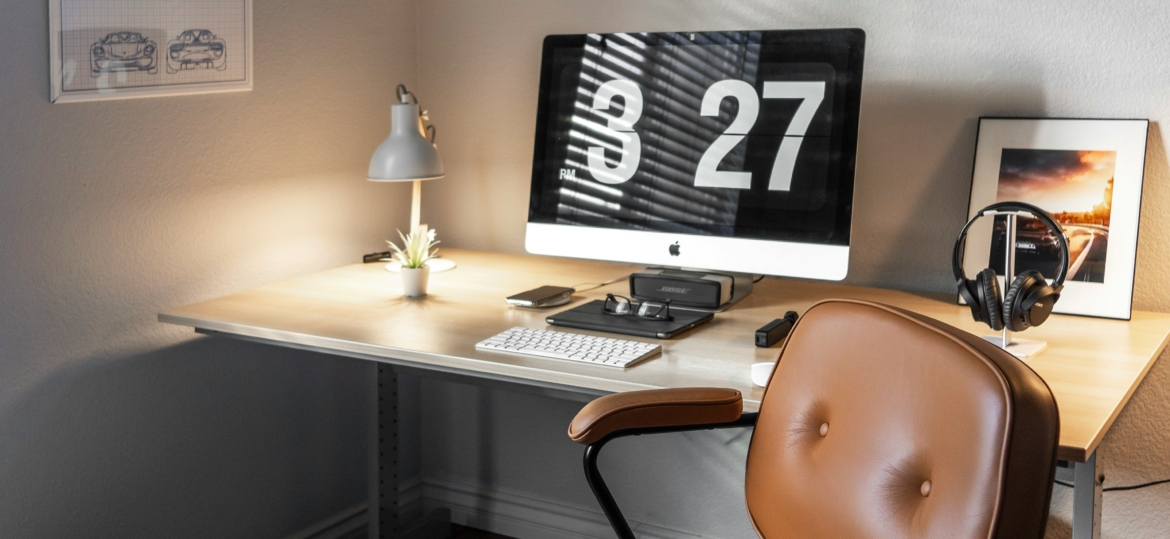
A Chesterfield desk chair can look perfectly at home beside a beautiful timber desk, yet still be frustrating to use if the proportions are wrong. Arms can catch against the desktop, a pedestal can restrict knee clearance, or an oversized chair can dominate a relatively compact home office.
That’s why learning how to match a Chesterfield desk chair with your desk should start with measurements, not leather colour. We’d first make sure the chair lets you sit comfortably at the desk, then consider proportion and finally bring the two pieces together through leather and wood finishes.
At Chesterfield Sofa Company, we make our office chairs to order in our Lancashire workshop, so we’re used to considering the chair as part of the wider room rather than simply as an individual piece of furniture. Our Chesterfield office chair range includes different sizes and silhouettes, as well as fixed and swivel options, which means the right combination depends heavily on the desk you already own.
Start With the Space Under Your Desk
Before looking at upholstery or wood finishes, measure the opening you’re actually going to sit within.
You need the floor-to-underside height of the desk rather than the height of its top surface. On a pedestal desk, also measure the clear width between the two pedestals. If there’s a drawer, apron or modesty panel underneath, check how much depth remains for your knees as well.
This is particularly important with a substantial traditional office chair. The HSE’s workstation checklist specifically warns that chair arms can prevent somebody from getting close enough to their equipment and recommends removing obstructions beneath the desk.
For another useful reference point, US OSHA workstation guidance recommends sufficient space under a work surface to change sitting position freely. Its example clearance dimensions include at least 52 cm of width, 44 cm of knee-level depth and 60 cm of depth at foot level, although these are workstation guidelines rather than dimensions every traditional desk must follow. See OSHA’s under-desk clearance guidance.
An antique pedestal desk can be particularly deceptive here. It may have a generous overall width but a relatively narrow space between the pedestals, so never judge compatibility from the desktop dimensions alone.
Set the Chair Height for You Before Matching It to the Desk
One mistake we’d avoid is lowering the chair simply because its arms need to fit beneath the desk.
Your sitting position comes first.
According to the HSE’s guidance on good workstation posture, the keyboard should sit just below elbow height, the thighs should be supported evenly and there should generally be around 2 to 3 cm between the front of the seat and the back of the knee. Your shoulders should also remain relaxed rather than being raised towards the ears.
Set the seat height where your body is comfortable, then measure the relationship between the chair and desk from that position.
If a fixed-height desk is too high once the chair is positioned correctly, raising the chair and adding a suitable footrest can be preferable to adopting an awkward working position. OSHA gives similar advice for fixed work surfaces that can’t be lowered.
This approach is especially useful when choosing a leather office chair for regular computer work rather than occasional reading or paperwork.
Arm Height Is Often the Measurement People Forget
Seat height gets plenty of attention when choosing an office chair. Arm height is just as important when you’re pairing it with a desk.
If the arms sit higher than the underside of your desk, you might find yourself permanently sitting too far away. That tends to move your keyboard and mouse further from your body and encourages reaching forwards.
It’s a problem that comes up repeatedly in real-life office chair discussions. For example, users in OfficeChairs discussions about armrests and desk clearance describe otherwise comfortable chairs preventing them from moving close enough to their desks because the arms project too far forwards.
We’d check two positions before ordering.
First, measure the chair in its normal working position. Then work out whether you want it to slide partly or completely beneath the desk when you’ve finished working. A chair can work perfectly while you’re sitting in it yet be impossible to tuck away afterwards.
That’s what we think of as the difference between working fit and parked fit.
It sounds simple, but it’s one of the most useful checks you can make when deciding how to match a Chesterfield desk chair with your desk.
Match the Scale of the Chair to the Desk
Once you’ve established that everything physically fits, look at desk proportions.
Our office chairs vary considerably in scale. For example, our Captain’s Chair is 640 mm wide and 470 mm deep. The Gainsborough Chair is also 640 mm wide but has a deeper 600 mm footprint, while our Director’s Chair measures 840 mm wide and 700 mm deep.
Those differences become very noticeable once the chair sits behind a desk.
| Desk style | What we’d look for |
| Large executive desk | A higher-backed or more substantial chair such as the Director’s can balance the scale well, provided the desk opening is wide enough. |
| Traditional pedestal desk | Measure between the pedestals carefully. A Gainsborough or Captain’s Chair can provide traditional character without automatically assuming the largest chair is best. |
| Compact writing desk | A relatively contained chair such as the Captain’s can prevent the seating from overpowering the desk. |
| Antique desk | Prioritise underside height, drawers and knee clearance before choosing the chair style. Older furniture doesn’t necessarily follow modern workstation proportions. |
Proportion doesn’t mean both pieces need to be physically similar in size. We want the chair to have enough presence to hold its own behind the desk without appearing squeezed into the available space.
Leave Room for the Chair to Move, Not Just Sit Still
Static measurements only tell you part of the story.
A swivel Chesterfield office chair also needs enough floor area for its base, castors and arms to move as you sit down or turn away from the desk. Our Captain’s Chair is available with either a traditional stand or tilt-and-swivel action, while the Gainsborough swivel version uses a five-star hardwood base with castors.
Before buying, we’d use masking tape to mark the approximate chair width and depth on the floor. Then pull an existing chair back as though you’re standing up from the desk.
You’ll quickly spot problems that aren’t obvious from a product photograph, such as a bookcase directly behind you or a doorway that becomes awkward once the chair is pulled out.
This is particularly useful in a smaller home office where every part of the office layout has to work harder.
Then Match Leather Colour to the Desk Finish
Once the dimensions work, you can concentrate on the enjoyable part.
There’s no rule saying a leather desk chair has to match the wood exactly. In fact, we normally prefer either a clearly coordinated pairing or a deliberate contrast rather than trying unsuccessfully to find two almost identical shades.
With a mahogany desk, antique brown creates a very traditional combination, while deep green or antique red can give the chair more identity. Black leather produces a more formal executive look.
Alongside an oak desk, warmer tan, caramel or honey-toned leather can keep the scheme lighter. Dark green also works particularly well where you want the traditional character of Chesterfield office furniture without making every surface brown.
For dark oak or walnut, you can either continue the depth with espresso and dark brown leather or introduce contrast with a lighter tan. With a contemporary painted desk, colours such as black, navy and grey can bring traditional buttoning into a cleaner modern office.
These aren’t fixed rules. They’re combinations we’d use as starting points before looking at the actual desk in the room.
Our chairs can be ordered in more than 100 premium leathers, while available wood stains include mahogany, dark oak, medium oak, light oak, walnut, Jacobean and teak. We also provide free upholstery samples, which is far more reliable than judging subtle leather colour from a screen. See the leather and wood options on our Captain’s Chair.
A sample is especially worthwhile if you’re pairing the chair with antique furniture, as existing timber can have considerable variation in tone and finish.
Don’t Try to Match Every Detail
A good desk and chair combination should feel related, not like a furniture set assembled from identical finishes.
If your desk already has a strong mahogany grain, for example, matching it with mahogany-stained chair timber can provide continuity while allowing the leather colour to become the contrast. Alternatively, a dark leather chair beside a lighter oak desk can make the chair the visual anchor of the room.
The studs give you another detail to work with. We offer finishes including brass, copper, chrome and oxidised studs, so you can pick up smaller details elsewhere in the office without forcing the leather and desk to match exactly.
Look at handles, lamps and other visible metalwork already around the desk. A little repetition usually feels more considered than matching absolutely everything.
Measure Before You Order
If you’re choosing an office chair for an existing desk, we’d have these measurements to hand before making the final decision:
- floor to the underside of the desk
- clear width between drawers or pedestals
- knee depth beneath the desk
- your comfortable seat height
- chair arm height at that seating position
- available floor space behind and beside the chair
Don’t rely on the chair’s overall height alone. A measurement such as 1,040 mm tells you how tall the chair is, but not whether its arms will clear your particular desktop.
Because our Chesterfield furniture is made to order, we can also discuss bespoke requirements rather than expecting every customer and every desk to fit one standard specification. Our product information notes that custom sizing can be considered to suit the room or the person using the furniture.
Finding the Right Chesterfield Desk and Chair Combination
The best desk and chair combinations get the practical details right before considering colour.
Start with your own sitting position. Check the desk height and the true opening beneath it, including any drawers or pedestals. Make sure the chair arms won’t prevent you getting comfortably close, then allow enough space for the chair to swivel and pull away.
Only after those points work would we choose the leather colour and wood finish.
That’s ultimately how to match a Chesterfield desk chair with your desk without compromising either comfort or appearance. A well-proportioned Chesterfield chair shouldn’t simply look impressive behind a desk. It should feel as though both pieces were always intended to share the same office.
At Chesterfield Sofa Company, we’ve been creating bespoke Chesterfield furniture since 1982, with every piece handmade in our Lancashire workshop. Our office chairs can be tailored through your choice of leather, wood stain and finishing details, allowing us to create something that works with the desk and room you’ve already chosen. Explore our Chesterfield office chairs.