
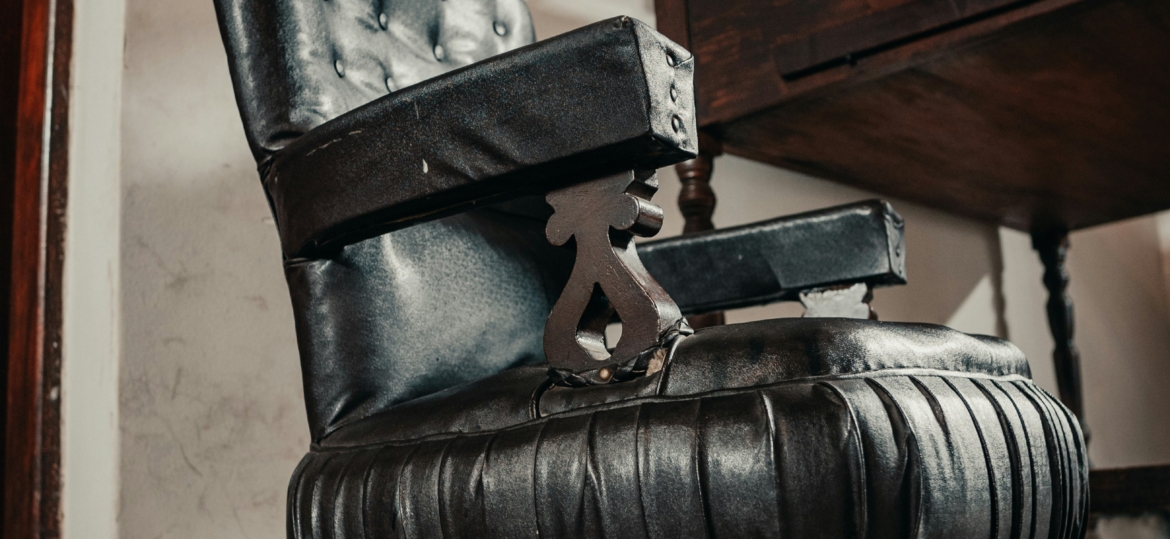
A traditional leather office chair can set the tone for an entire workspace, but choosing between two established Chesterfield designs involves more than deciding which one looks best. A Captain’s Chair and a Gainsborough Chair differ noticeably in back height, depth, arm design and the amount of visual space they occupy around a desk.
If you’re comparing a Captain’s Chair vs Gainsborough Chair, the simplest distinction is this: the Captain’s Chair is the lower, more compact-looking design, with its curved back and turned wooden spindles. The Gainsborough is taller and deeper, with a prominent buttoned back and exposed polished timber arms. Both can work beautifully in an executive office or home study, but they create very different relationships with the desk and the room around them.
At Chesterfield Sofa Company, we make both styles to order in our Lancashire workshop. That gives us a useful perspective on something that’s often missed when these chairs are compared online: chair proportions and desk compatibility should be considered before colour or leather upholstery.
Captain’s Chair vs Gainsborough Chair at a Glance
| Overall character | Compact, rounded and distinctive | Taller, more formal and architectural |
| Back | Lower curved back with turned spindles | High, deep-buttoned upholstered back |
| Arms | Curved rail forming part of the back | Open polished wooden arms |
| Width | 640mm | 640mm |
| Traditional stand height | 840mm | 1030mm |
| Listed overall depth | 470mm | 600mm |
| Best suited to | Smaller offices, traditional desks and rooms where you don’t want the chair dominating | Larger desks, executive offices and rooms where the chair can have more presence |
| Base options | Traditional stand or tilt and swivel | Traditional stand or tilt and swivel |
These measurements come directly from our Chesterfield Captain’s Chair specifications and Gainsborough Chesterfield Office Chair specifications. As every chair is made to order, we can also discuss custom sizing where standard proportions aren’t right for the room or the person using it.
Choose the Captain’s Chair If You Want a Lower, More Open Design
The Captain’s Chair is immediately recognisable from its curved back, with turned wooden spindles inspired by the railings found on traditional timber ships. Rather than placing a tall upholstered panel behind you, the design creates a lower horizontal line across the room.
Our traditional stand Captain’s Chair is listed at 840mm high, compared with 1030mm for the Gainsborough. They’re both 640mm wide, so the biggest visual difference isn’t how much space they take from side to side. It’s what happens above and behind the desk.
That makes the leather Captain’s Chair particularly useful when you’ve got an attractive traditional desk that you don’t want to hide. From the other side of the room, more of the desktop, surrounding joinery and wall remains visible. In a smaller home study, it can also prevent the desk area from becoming too visually heavy.
The chair still has plenty of Chesterfield character. A buttoned or plain seat can be specified, while the visible timber, individual hand-tacked studs and leather give it the finish you’d expect from a classic leather desk chair. Our frames are made from beechwood, glued, screwed and dowelled for strength, and carry a 10-year frame warranty. Chesterfield Sofa Company
Choose the Gainsborough If You Want More Height and Presence
The Gainsborough takes a different approach. Its polished wooden frame surrounds a deep buttoned seat and back, with open wooden arms linking the two. Instead of the Captain’s low, curved profile, you’ve got a high back that creates a much stronger vertical shape.
On our standard traditional version, the Gainsborough is 190mm taller than the Captain’s Chair. Its listed overall depth is also 600mm rather than 470mm. Chesterfield Sofa Company
Those differences become important around a substantial partner’s desk, boardroom table or large executive desk. A smaller chair can sometimes look lost beside a particularly heavy piece of office furniture. The proportions of a leather Gainsborough chair give it enough presence to sit comfortably alongside larger desks without the furniture looking mismatched in scale.
The high back is also useful when you actively want the chair to form part of the room’s visual focus. Deep button tufting gives you a larger area of leather on display, so your choice of hide and colour has more impact. Antique green or deep brown can reinforce a traditional interior, while choosing a less conventional leather can give the same frame a very different character.
Don’t Choose Either Chair Until You’ve Measured Your Desk
One of the biggest mistakes we see with premium office furniture is choosing a chair based on the room and forgetting to measure the desk itself.
Check the desk height, but also measure from the floor to the lowest obstruction underneath it. A drawer, supporting rail or thick desk apron can reduce clearance considerably. Then think about where the chair’s arms will sit when you’ve adjusted yourself to a comfortable working height.
This isn’t simply a question of keeping the room tidy by pushing the chair underneath. The Health and Safety Executive’s workstation checklist specifically warns that chair arms can prevent a user getting close enough to their equipment comfortably.
It’s a problem people run into in real offices. In one recent discussion about office-chair armrests and desk clearance, the user found that lowering the chair enough to get the arms beneath the desk then left their legs in the wrong position. The chair itself wasn’t necessarily the problem. The chair and desk simply weren’t working together.
With a traditional office chair, that measurement is worth taking before you settle on the design.
Think About How You’ll Actually Sit in It
Looks are important when you’re buying handcrafted furniture, but a chair used for several hours at a desk has a different job from one used occasionally for reading, meetings or paperwork.
The HSE recommends setting a workstation so the keyboard sits just below elbow height, the thighs are supported and the lower back has appropriate support. It also recommends leaving roughly 2 to 3cm between the front of the seat and the back of the knee. HSE
That means there isn’t a universal winner in the Captain’s Chair vs Gainsborough Chair comparison. Your height, desk and preferred seating posture all affect the answer.
For regular desk work, we’d generally look first at a tilt and swivel configuration rather than choosing a fixed base purely for its appearance. Both our Captain’s and Gainsborough designs can be ordered with tilt and swivel action, while the traditional stand versions offer a fixed seating position. Chesterfield Sofa Company
It’s also worth considering how intensively the chair will be used. The HSE says its Display Screen Equipment guidance applies to workers using screens daily for continuous periods of an hour or more. HSE If you’re furnishing a workplace for prolonged computer use, assess the finished chair and workstation together rather than assuming any traditional office chair will automatically suit every user.
Which Style Works Best With Your Interior?
A Captain’s Chair tends to sit naturally in a study where there are already strong horizontal features, such as a broad writing desk or fitted bookcases. Because the back is lower and partly open, it brings traditional detailing into the room without creating a large block of leather behind the desk.
The Gainsborough suits interiors where you want the chair to play a bigger part in the design. Its high back, buttoning and exposed timber frame work particularly well with substantial wooden desks and formal executive office furniture.
Colour can change either chair significantly. We offer both designs in more than 100 premium leathers and fabrics, with choices covering the stud colour, button colour and wood stain. Different seat fillings are available as well. Chesterfield Sofa Company
Rather than automatically pairing dark brown leather with dark timber, look at what’s already competing for attention in the room. If the desk has a particularly rich grain or detailed carving, a more restrained leather can stop the combination becoming too busy. If the surrounding furniture is simple, a distressed or antique-style leather can give the chair more character.
So, Which Should You Choose?
For most people weighing up a Captain’s Chair vs Gainsborough Chair, we’d make the decision around scale first.
Choose the Captain’s Chair when you prefer a lower profile, want more of the desk and surrounding room to remain visible, or you’re working with a more compact office. Its curved spindle back is also the more distinctive choice if you’re specifically drawn to the traditional Captain’s chair shape.
Choose the Gainsborough when you want a taller chair with stronger visual presence. Its high buttoned back and exposed wooden arms make it particularly effective beside a substantial desk or in an executive office where the chair needs to hold its own within the wider interior.
Neither style needs to be bought as an off-the-shelf compromise. Our Chesterfield office chairs are handmade in Great Britain in our own Lancashire workshop, and both designs can be made in a wide range of leathers, wood finishes and configurations. We can also discuss custom dimensions where your desk, room or individual requirements call for something different.
If you’re still deciding between a Captain’s Chair vs Gainsborough Chair, we’d recommend measuring the desk opening and the space behind it first. Once we know those dimensions and how you’ll use the chair, we can help you choose the design and specification that will look as though it was always intended for the room.